 Simply BP
How to Measure Blood Pressure at Home, Step by Step
By Simply BP ·
This article is about keeping records, not medical advice. Talk to your doctor about your own readings.
A blood pressure reading taken at home can tell your doctor a great deal, but only if it's taken the same careful way every time. Small things move the numbers: a full bladder, a cup of coffee, crossed legs, a cuff pulled over a sleeve. This is the routine that published guidance on home readings describes, step by step, and how to write the results down so they're useful at your next appointment.
One thing before we start: if your doctor has given you a routine of their own, follow theirs. Everything below describes the usual approach; your doctor knows your situation.
Why readings at home are worth it
A reading at the doctor's office is one moment, often after a rushed journey and a wait in a busy room. Some people's numbers run higher there than at home, and for others it's the other way round. Readings taken at home over several days fill in the rest of the picture. That's why the American Heart Association and the European Society of Hypertension give home readings a real place in their guidance, as long as they're taken carefully.
What you need
- An automatic upper-arm cuff. Guidance prefers an upper-arm device that has been checked for accuracy (validated) over wrist or finger devices. If you're not sure about yours, take it to your next appointment and ask.
- A cuff that fits your arm. The band printed on the cuff shows the arm sizes it's made for. A cuff that's too small tends to give higher numbers, and one that's too large tends to give lower ones.
- A quiet chair next to a table. You'll rest your arm on the table, so a dining table or desk works better than a sofa.
- A pen and your log. A paper sheet or a notes page, as long as every reading goes in the same place.
The 30 minutes before
In the half hour before a reading, avoid caffeine, exercise and smoking. Each of them can push the numbers up for a while, and the reading would then say more about your coffee than about your usual blood pressure. Use the bathroom first, too: a full bladder can add a few points.
How to sit
The way you sit matters more than most people expect. The routine in the AHA/AMA statement on home readings looks like this:
- Sit on a chair with your back supported and both feet flat on the floor. Don't cross your legs.
- Rest your arm on the table so the cuff sits at the level of your heart. A cushion under your arm helps if the table is low.
- Put the cuff on your bare upper arm, with its lower edge just above the bend of your elbow. A rolled-up sleeve can squeeze the arm, so take the sleeve off instead.
- Keep still and quiet: no talking, no phone, no TV with the news on.
Rest five minutes first
Once you're sitting with the cuff on, wait five minutes before pressing the button. It feels long, and it's the step people skip most often. A reading taken straight after walking in from the kitchen is usually higher than one taken after a proper rest.
Two readings, a minute apart
Take a reading, wait about a minute, then take a second one. Write both down, exactly as the screen shows them: the top number (systolic), the bottom number (diastolic) and the pulse.
The two readings won't always match, and that's normal. Don't keep going until you get a number you like. Write down what you got; your doctor reads the whole picture, not one perfect number.
Morning and evening
Guidance usually asks for readings at two times of day:
- Morning: within about an hour of getting up, after using the bathroom, before breakfast and before your morning medicines.
- Evening: before going to bed.
Try to keep roughly the same times every day. Readings taken at random moments are hard to compare, while the same two moments each day make a pattern your doctor can read.
Use the same arm every time
At a first visit, your doctor may check both arms. Readings can differ between arms, and guidelines usually suggest using the arm that gave the higher numbers from then on. Whatever arm you use, use the same one each time and write down which one it was.
What to write down
For every reading, write the date and time, the top and bottom number, the pulse, the arm, and a short note if anything was unusual: a late night, a missed dose, pain, a stressful day. There's more detail in our article on what to write in a blood pressure log.
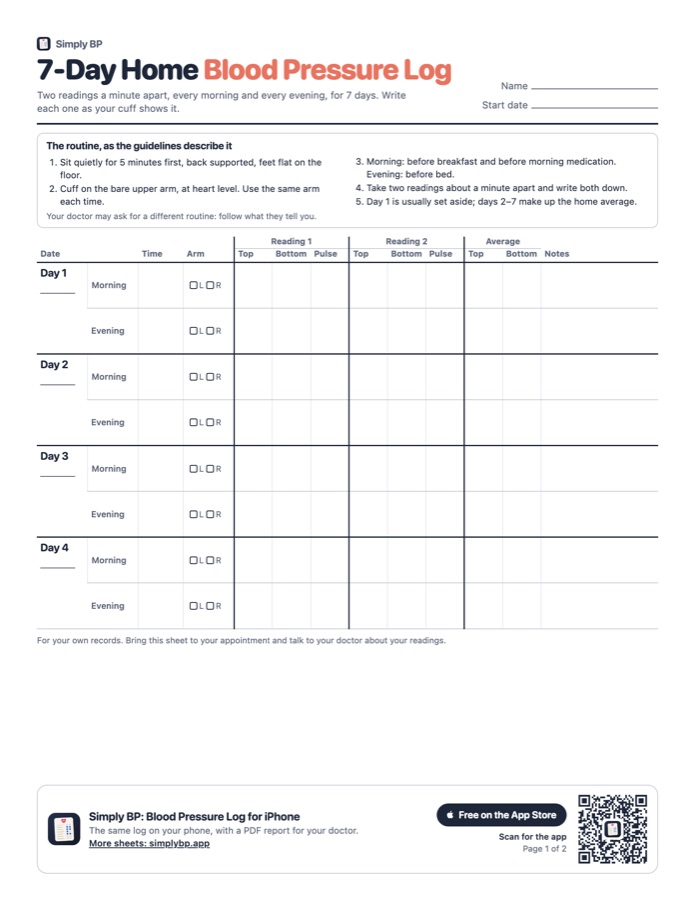
Two pages for the 7-day home routine: two readings morning and evening, with the steps on the sheet.
Download the 7-day log (PDF)The same log on your iPhone, with a PDF report for your doctor.
Coming soon to the App StoreHow many days
Before an appointment, doctors often ask for a week of readings taken this way, morning and evening. The European guidelines describe leaving out day 1, because first-day readings tend to run high while you get used to the routine, and averaging days 2 to 7. The 7-day sheet above is laid out exactly for that, and there are more sheets on the printable log page.
Common mistakes
These are the slips that most often make home readings hard to use:
- the cuff over a sleeve, or a sleeve rolled up tight above it;
- talking or checking the phone during the reading;
- taking the reading straight after climbing stairs or carrying shopping;
- an arm hanging down by your side instead of resting at heart level;
- rounding the numbers, or writing them down later from memory;
- writing down only the readings that looked good.
Taking readings for someone else
If you help a parent or partner with their readings, the same routine applies to them: the five-minute rest, the same arm, two readings a minute apart. Keep their readings on a separate sheet with their name at the top so nothing gets mixed up, and let them sit quietly rather than chatting while the cuff inflates. If they take their own readings, sitting next to them for the first few days helps the routine stick.
When a reading worries you
One high or low reading on its own isn't a reason to act by yourself. Write it down, keep to the routine, and bring the log to your doctor, who decides what it means for you. If you ever have a very high reading together with chest pain, shortness of breath, weakness, numbness, changes in your vision or trouble speaking, call your local emergency number.
Keeping the log on your phone
Paper works well. If you'd rather keep the same log on your iPhone, Simply BP is a blood pressure diary: you type in the numbers from your own cuff, and it keeps the history, guides you through the 7-day home check and turns it into a one-page report for your doctor. It's coming to the App Store soon: see when it's out.
Sources
- Shimbo D, et al. Self-Measured Blood Pressure Monitoring at Home: A Joint Policy Statement From the American Heart Association and American Medical Association. Circulation. 2020;142(4):e42–e63. https://doi.org/10.1161/CIR.0000000000000803
- Whelton PK, et al. 2017 ACC/AHA Guideline for the Prevention, Detection, Evaluation, and Management of High Blood Pressure in Adults. Hypertension. 2018;71(6):e13–e115. https://doi.org/10.1161/HYP.0000000000000065
- Mancia G, et al. 2023 ESH Guidelines for the management of arterial hypertension. J Hypertens. 2023;41(12):1874–2071. https://doi.org/10.1097/HJH.0000000000003480
This article is about keeping records, not medical advice. Talk to your doctor about your own readings.